What Is the Difference Between a Betting Exchange and a Bookmaker?
 playbaazi
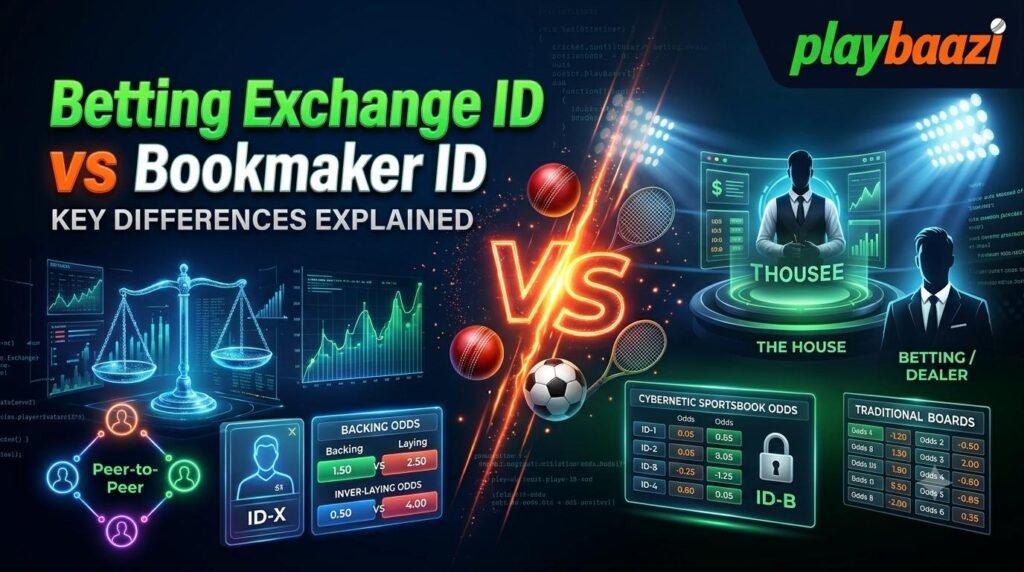
There are a few distinctions between betting exchanges and bookmakers, the main ones being who provides the odds and who fulfills the other side of the deal. In betting exchanges, individual bettors determine the odds for themselves, and the house essentially plays the middleman for a commission. With a traditional bookmaker, however, the bookmaker determines the odds, and customers bet against the bookmaker, whose interest is in minimizing his exposure to losing money on bets.
It helps to know how betting exchange and bookmaker models work and differ from each other to know the difference in pricing systems and the risk levels they involve. From a betting perspective, it helps to understand their structural differences and the different services they provide.
What Is a Betting Exchange?
Betting exchanges function on the principal of providing users the opportunity to buy and sell outcomes on events to one another. Rather than the betting exchange determining the prices at which betting occurs, each bettor is the price maker.
As a betting exchange, the betting exchange’s function is similar to a booking platform for bets, and charges fees on completed matches between bets. As in any betting environment, a bet is not a bet without someone on the other side.
What Is a Bookmaker?
The odds setter, commonly known as a bookmaker, is an individual or an entity who runs the betting line for an upcoming game. A bookmaker takes on the betting risk for their customer.
The odds setters will take on some betting risk by setting odds. One of the risk mitigation strategies employed by bookmakers is setting odds with a built in margin. Market events and customer betting behaviors can influence a bookmaker’s odds setting process.
Bookmakers generally will accept an opposite betting position without another betting customer. They offer the betting terms to their customers.
Betting Exchange vs Bookmaker: Key Differences
There are differences related to market structure, pricing, fees, and responsibilities.
1. Who Controls the Odds?
In an exchange system, offers made by participants can influence prices. In this model, the exchange matches two opposing offers.
In a bookmaker system, the operator sets the odds. The bookmaker can also adjust them to match its pricing policies and its own assessment of the event.
2. Who Takes the Other Side?
With an exchange system, two participants take two opposing sides and the exchange matches the two sides.
With a bookmaker system, the bookmaker takes the other side of a participant’s position and, as a result, has direct exposure to the outcome.
3. How Does the System Make Money?
With an exchange system, the system makes money by charging a fee to participants either for taking or for providing liquidity.
With a bookmaker system, the bookmaker makes money by offering odds at a level that incorporates a margin for the bookmaker to cover the costs and to manage the risk.
4. How Does the Market Work?
Participants make offers, and the prices change accordingly. The market also relies on the availability of market participants.
The bookmaker controls the odds and can change them at any time based on the bookmaker’s perception of pricing and the level of risk the bookmaker is prepared to take.
5. What Are the Main Risks?
There are many financial and consumer risks with both of these systems, including the use of deceptive pricing, unlisted fees, the security of account systems, payment disputes and the potential for financial loss.
It is also important for potential users to understand that the appearance or an account system of a given system is not a measure of whether a given system is legal in their jurisdiction.
What Are Betting Exchange Platforms?
Betting Exchange Platforms can be best understood as an adaptation of the marketplace model. Betting Exchange Platforms can encompass features like order matching and pricing systems, account and transaction systems and services that maintain betting listings.
The betting exchange systems offer an online interface, however this system can easily be confused with a system that is legally allowed. It is recommended to understand the operating legal structure, privacy policies and security practices, ownership information and regulations prior to evaluating an online system.
Is There a Difference in Account Structure?
Yes. An exchange may use account details to identify participants and maintain records of matched transactions. A bookmaker also uses customer accounts for identity checks, account management, and transaction records.
A Betting Exchange ID is only an identifier. It should never be treated as proof of platform authenticity or permission to provide a regulated service. Avoid sharing passwords, OTPs, or banking information with unknown individuals.
Legal Considerations in India
India’s Promotion and Regulation of Online Gaming Act, 2025 prohibits online money games, along with their advertising, promotion, and facilitation. The framework applies to online money games involving chance, skill, or a combination of both. The rules came into force on 1 May 2026.
Therefore, the legal status of a service should be checked before engaging with it. Do not assume that an overseas website or a service operating through a third party is permitted in India.
FAQs
Q1. What is a betting exchange?
It is like a marketplace with two sides to it. It has one group wanting to place a bet, and another group who want to be the one who accepts that bet.
Q2. What is a bookmaker?
A bookmaker takes and accepts bets.
Q3. What is the difference?
An exchange has two people who place their bets against each other, whereas a bookmaker is the one who places the bet.
Q4. What is a betting exchange ID?
It does not have any legal or legitimate standing of any betting service provider.
Q5. Is online real money betting legal in India?
Online games of chance or games involving a prize and any service that helps to offer those games is against the law in India, under the Promotion and Regulation of Online Gaming Act 2025.